The Upside-Down of Engineering
What Are Reverse-Cognition Engineers And Why They Are Going to Become the Highest-Leverage Builders of the Next Decade
For decades, software engineering relied on what will be referred to during this blog post as ‘forward cognition’: a step-wise, bottom-up mental model where developers accumulate primitives, combine them into patterns, and eventually build systems. This made sense when humans were the sole engines of implementation.
But AI has changed the very physics of what and how building is done. A new cognitive architecture is emerging, and it is visible in the already well-established legitimacy of context engineering and now, agent-engineering. These aren’t trends attacking our feeds — they are a token of a much deeper paradigm shift: engineering that no longer begins with implementation steps at all, but with constraints, boundaries, and system-level structure, using AI as the executor. This model is reverse cognition.
It is becoming the defining thinking style of high-leverage AI engineers. The industry is not prepared, but was it prepared for anything 3 years ago? This paradigm shift is not only in how we build — AI practitioners will have to make a deep structural adaptation in their very core perceptions about what might have been their trade for the last 2, 5, or 20 years.
Forward Cognition: How Traditional Engineering Thinks
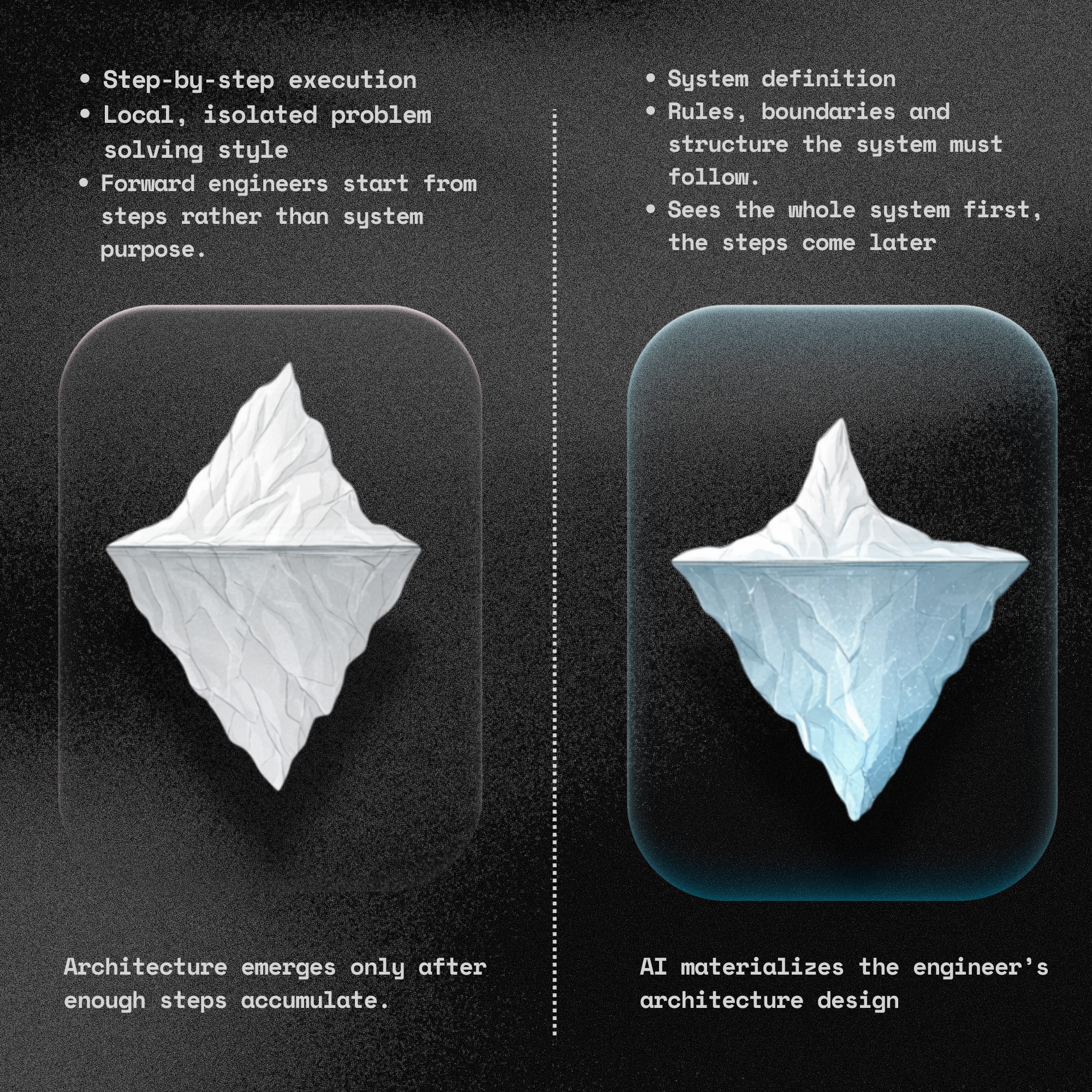
Traditional engineering follows a predictable developmental arc. You begin by learning primitives - syntax, data structures, and basic algorithms. You graduate to compositions - libraries, frameworks, design patterns. Eventually, architectural intuition emerges. Only then, do you reliably build systems. Refinement comes after something already exists. This is step-first cognition.
In an AI-native environment, this model becomes slow, granular, cognitively inefficient. Engineers’ ability to debug or accelerate the roadmap depends on memorized patterns, and is deeply prone to tunnel-vision inferno.
Reverse Cognition: System-First Thinking for an AI World
Reverse cognition flips the mental stack entirely. Instead of “What steps should I take to build this?” the engineer begins with a far more powerful question: “What constraints, invariants, and structural truths must a correct version of this system obey?” Only once these rules are articulated, the AI is instructed to instantiate them.
This inversion shifts the engineer’s work from assembling steps to defining boundaries. The engineer specifies the invariants, interfaces, data flows, evaluation criteria, and non-negotiables. The AI then produces implementation candidates within those rules. Iteration occurs at the architectural level, not at the syntactic one. The human starts from the finished shape of the system, defines the rules of correctness, and delegates the mechanical search through implementation space to the AI.
This new generation of engineers is pissing off a lot of other senior engineers — scaring, baffling, and intriguing ambitious founders all at the same time. Because of this mental model, these engineers can out-ship and out-skill entire engineering squads without tinkering with 90% of the implementation themselves.
Forward Cognition vs. Reverse Cognition Iceberg Model
Why Reverse Cognition Works So Well With the AI Domain
AI is notoriously poor at defining constraints, making architectural trade-offs, anticipating failure modes, maintaining safety boundaries, or reasoning under ambiguity. Humans are built for exactly those tasks. Conversely, AI excels at generating code, transforming structures, producing variations, automating boilerplate, and filling in patterns. Reverse cognition aligns each agent — human and machine — with its natural strengths.
Forward cognition treats AI as an assistant. Reverse cognition treats AI as an instrument. And when two engineers start from the same baseline, the one using AI as an instrument, not as a helper, will finish the race by a landslide. Reverse cognition doesn’t add incremental speed — it multiplies leverage. It changes the slope of the curve.
Why Reverse Cognition Engineers Are The Future of AI Engineering
Reverse cognition allows a single engineer to operate at a scale that once required a team. It moves cognitive resources from syntax to design, reasoning, correctness, and safety. It accelerates delivery through parallelization — AI can generate multiple system variants simultaneously. And it lowers the traditional experience barrier without lowering quality, because quality stems from clarity of system definition, not from recollection of syntax.
Forward cognition asks the engineer to accumulate steps. Reverse cognition asks the engineer to define systems.
What It Means (for us)
The next generation of high-impact developers will not be the ones who merely “use AI tools.” They will be the engineers who think in systems rather than steps — who can define architectures with clarity and precision, and command AI to materialize them faithfully.
Reverse cognition is not a trick, nor a productivity hack. It is a cognitive architecture engineered for an era in which AI is a collaborator, not a tool. It is a new paradigm that is already here — a manifestation of the deeper why behind the emergence of the tools and techniques we use, a shift in how systems are conceived, structured, and materialize in the first place.